
The Red Crowned Parakeet is a small New Zealand parrot known for bright green plumage and a vivid red head pattern. This introduction sets expectations for a deep, long-form guide on identification, behavior, habitat, diet, breeding, threats, conservation, and responsible aviculture for U.S. bird enthusiasts.
The species, also called the red-fronted parakeet and kākāriki in Māori, draws searches because of striking looks, lively calls, and notable conservation wins on predator-free islands and fenced sanctuaries. Readers will learn to spot field markers like plumage contrasts, flight cues, and vocal patterns, and what matters in captive care and enrichment.
Grounded in taxonomy and widely cited references, the guide explains subspecies ranges, legal protections, and why the bird is Least Concern globally yet scarce on much of mainland New Zealand due to introduced predators. For a deeper species profile and conservation details, see this concise overview.
Red-crowned parakeet species profile
Key Takeaways
- Bright green plumage with a red head patch helps quick identification.
- Coverage includes wild habits, diet, breeding, threats, and care tips.
- Conservation has restored populations on predator-free islands.
- Field ID focuses on plumage markers, flight style, and vocal cues.
- Captive care requires species-appropriate diet, enrichment, and vet checks.
Meet the Red Crowned Parakeet: An Overview of New Zealand’s Kākāriki
Kākāriki is the Māori name for a small New Zealand parrot recognized by a green body and a vivid red forehead patch. These birds are active, curious, and often heard before they are seen. Bird lovers prize their lively chatter and bold color contrast.
Not to be confused with the South American species Pyrrhura roseifrons, the New Zealand bird is Cyanoramphus novaezelandiae. This clarification helps U.S. readers avoid mixing regional species when researching care, sightings, or photos.
Where do you find them today? Mostly on offshore islands and in managed sanctuaries where predators are controlled. Sightings often start as sharp calls from the canopy.
- What to listen for: bright, chattering calls and quick flight notes.
- What to look for: green plumage with a red head accent and agile, flocked behavior.
- What to ask when buying: provenance, legal status, and captive-breeding records.
For a practical species summary and conservation background, see this kākāriki overview. The rest of this guide dives into classification, field marks, calls, habitat, diet, breeding, threats, and conservation actions.
Taxonomy and Scientific Name: Cyanoramphus novaezelandiae
Placing the bird in scientific context helps birders, researchers, and conservationists use a single name for accurate records and legal clarity. The formal label Cyanoramphus novaezelandiae ties field observations to museum data and protection measures.
Where it fits among parrots
The species belongs to the order Psittaciformes, the broad group that includes all parrots. Within that order, it sits in the family Psittaculidae, a lineage of mostly Australasian parrots and parakeets.
Recognized subspecies and island ranges
Isolation on separate islands has produced distinct subspecies across the region. That island-by-island story explains why local populations may look or behave slightly differently.
Kermadec Islands (C. n. cyanurus)
C. n. cyanurus occurs on the Kermadec Islands, northeast of New Zealand’s North Island. These remote islands host a unique island form.
Main population (C. n. novaezelandiae)
The nominate C. n. novaezelandiae is found across the North and Stewart Island/Rakiura regions and nearby satellites. Records also include southern groups such as the Auckland Islands.
Chatham Islands (C. n. chathamensis)
The Chatham Islands population is recognized as C. n. chathamensis. Endemic island forms like this are often top conservation priorities.
Macquarie Island († C. n. erythrotis)
The Macquarie Island form, †C. n. erythrotis, is extinct. Its loss is a reminder of how vulnerable island birds can be to introduced threats on isolated islands.
Taxonomy can change as genetics refine definitions. Using cyanoramphus novaezelandiae and noted subspecies names ensures clear communication for study, trade rules, and conservation work.
Field Marks and Plumage: Crown, Forehead Patches, and Wings
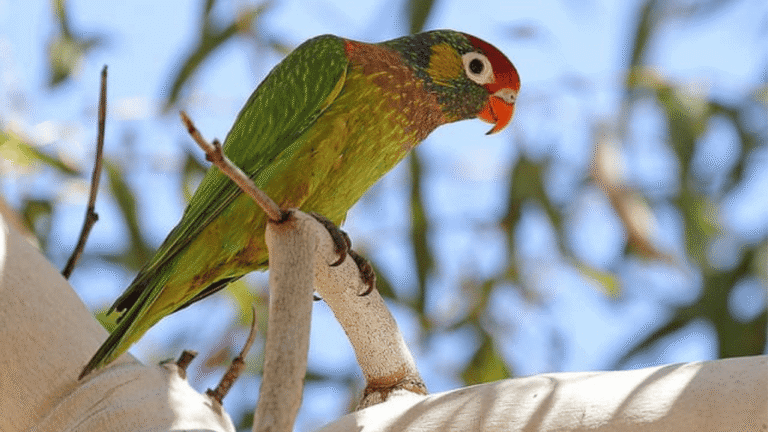
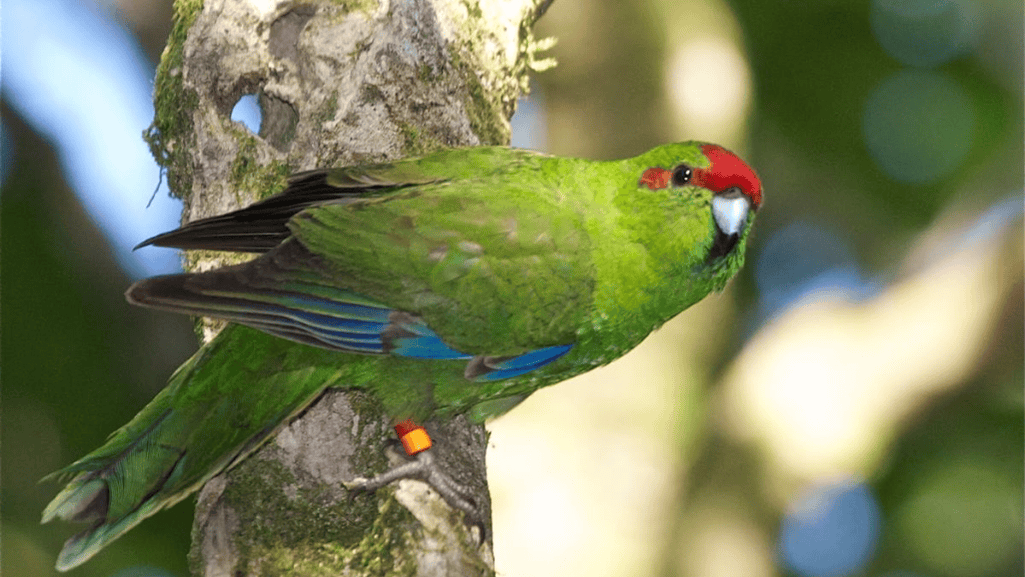
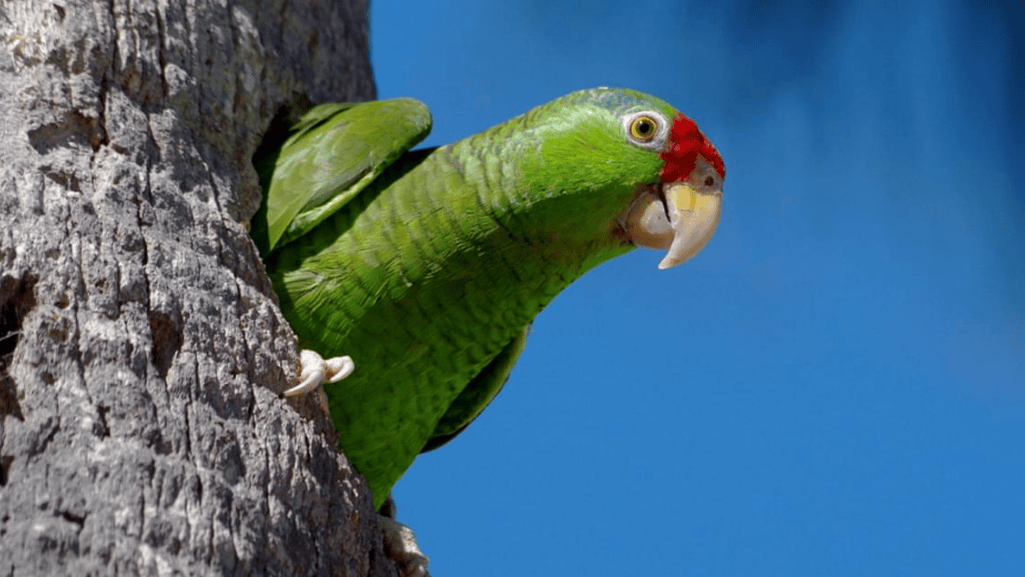
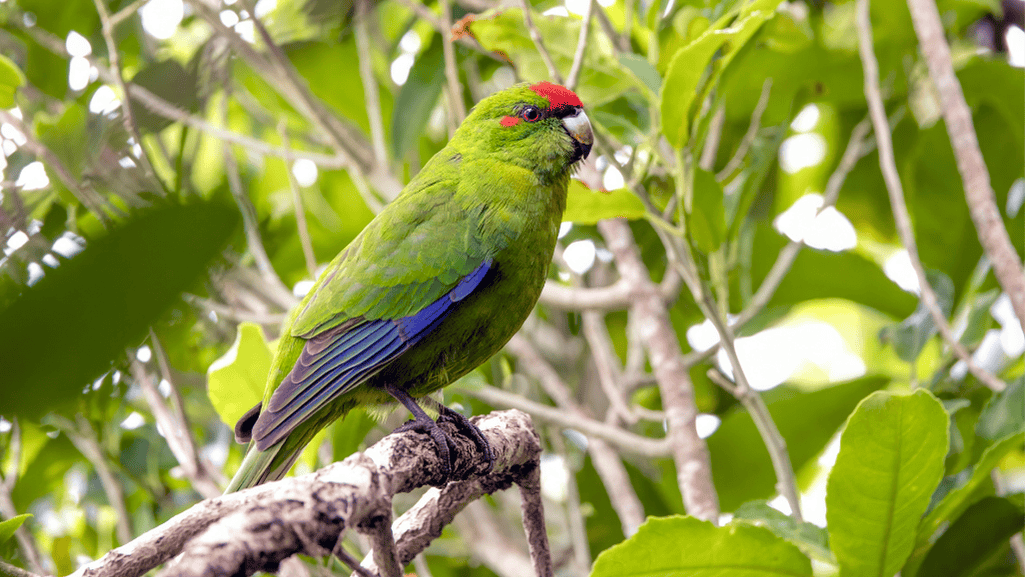
At a glance, the forehead and crown pattern are the quickest clues to a correct ID. Adults show bright yellow-green body plumage with a vivid crimson on the forehead and front of the crown that stands out in canopy light.
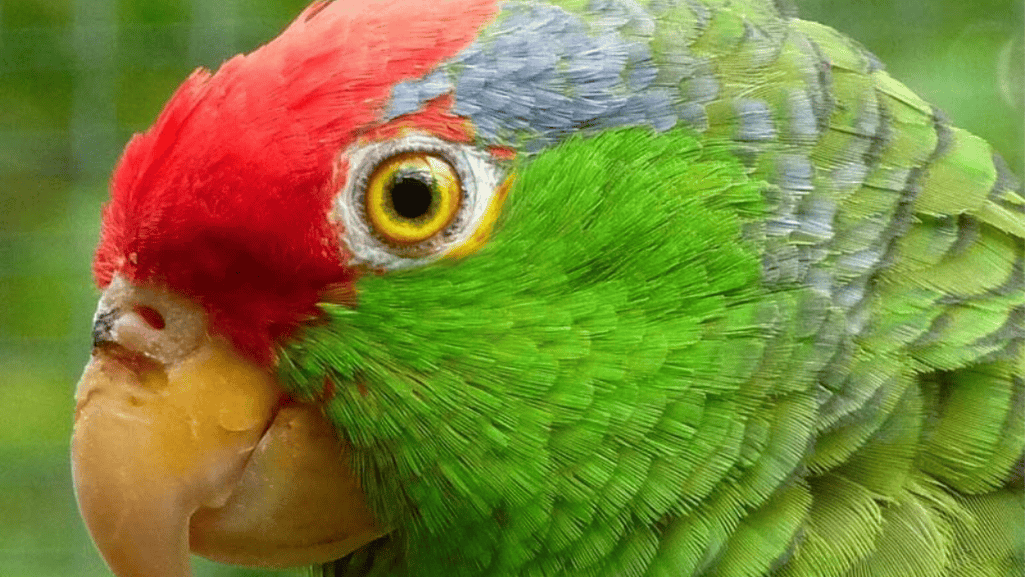
The facial layout includes crimson lores and distinct eye-stripes that help separate this species from other green parrots. The forehead appears as a solid block of color above the beak.
Look for small red patches on either side of the rump and a dark blue outerwing that flashes in flight. The long tail and slim silhouette are obvious when the bird moves through a tree or along forest edges.
Sex and Age Clues
Females tend to be slightly smaller and may show a thin yellow stripe on the underwing and a narrower bill. The male is generally larger with a stouter bill.
Juveniles show a pinkish tint to the bill and a dull brown iris that slowly reddens with age. Noting these features reduces misidentification when birds fly past in mixed trees or quick canopy checks.
- Quick ID tips: forehead/crown contrast, lores & eye-stripes, rump patches, wing flash.
- Silhouette: long tail, agile profile through trees.
- Aging: bill and iris shift on juveniles toward adult tones.
Calls and Vocal Behavior: How Red-crowned Parakeets Sound in the Forest
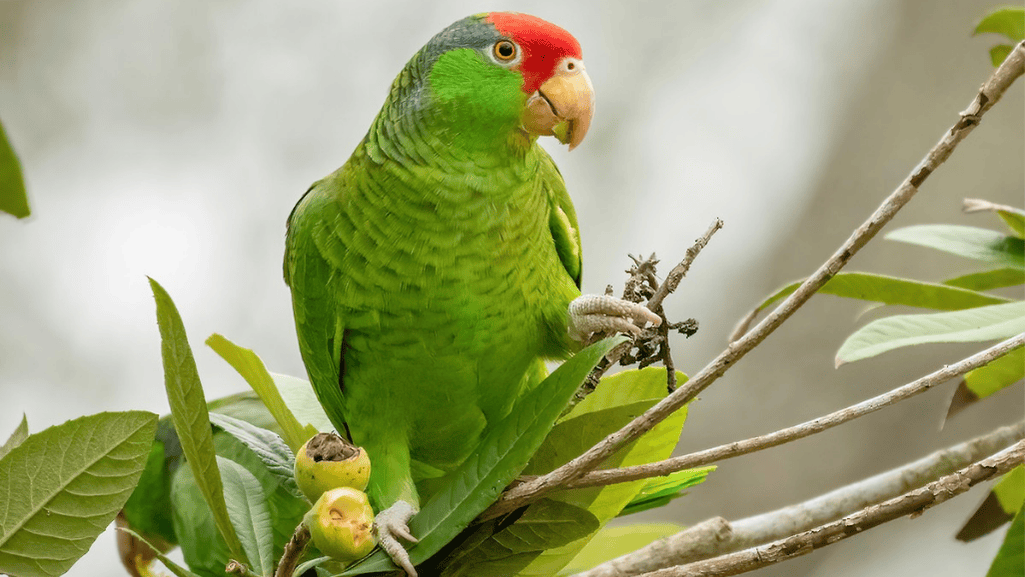
Listening in canopy light reveals two distinct call types: gentle social chatter and rapid flight calls that cut through wind. The everyday voice is a soft, musical chatter used during foraging and group contact. In sanctuaries and fenced reserves observers report long, high strings of “ka ka ka” during active social periods.
Soft chatter versus flight notes
Soft musical chatter is often low-pitched and steady. It helps keep flock members together while feeding in dense foliage.
Flight and takeoff calls are sharper: sequences like “ki-ki-ki-ki” or “kek-kik-kek” signal movement or alarm as birds lift from branches.
How to use sound for field ID
Vocal cues matter when visibility is poor. These birds blend into green leaves, so learning calls can lead you to a sighting faster than scanning the canopy.
- Compare: their calls are generally stronger and lower-pitched than the yellow-crowned counterpart.
- Behavioral cues: steady chatter = social contact; clicking or singing = courtship; siren-like notes = alarm.
- Monitoring notes: fenced sanctuaries often document long “ka ka ka” strings during communal activity.
Tip: Treat sound as part of an ID toolkit. Combine call quality, habitat, and quick flight flashes to confirm a record.
For a deeper species profile and recordings, see this detailed species introduction.
Habitat and Distribution in New Zealand and Offshore Islands
Where trees meet open ground, these birds find the mix of food, shelter, and nest sites they need. They use a range of habitats: deep temperate rainforests, coastal forest, scrubby margins, and forest edges where foraging is easier.
Preferred habitats
- Temperate rainforest interiors: dense canopy for roosting and safety.
- Coastal forest and scrub: rich in fruits, buds, and nesting holes.
- Forest edges and open areas: favored for feeding and quick movements between patches.
Where they persist today
Once common across both main islands, populations retreated after predators arrived. Today most records come from offshore, predator-free islands and a few mainland forest blocks.
Key strongholds and observation notes
- Best-known sanctuaries: Kapiti Island, Tiritiri Matangi, and Matiu/Somes, where management yields visible, dense flocks.
- Southern presence: the Auckland Islands and Stewart Island/Rakiura remain important refuges.
- Mainland pockets: Northland, the Coromandel, and central North Island hold scattered remnants; South Island records are rare and coastal.
Predator-free management boosts occupancy and bold behavior. On managed islands birds forage lower and call openly. On vulnerable mainland sites they often stay high in canopy and only descend near dense cover, which affects detectability.
Why this matters: habitat choice ties directly to diet and nest-site needs and sets the stage for considerations about feeding and breeding.
What Red-crowned Parakeets Eat: Seeds, Fruit, Flowers, and More
Food shapes daily movement and social foraging. This species is a flexible feeder and acts like a generalist, using many plant and animal resources across habitats.
Seasonal feeding shifts
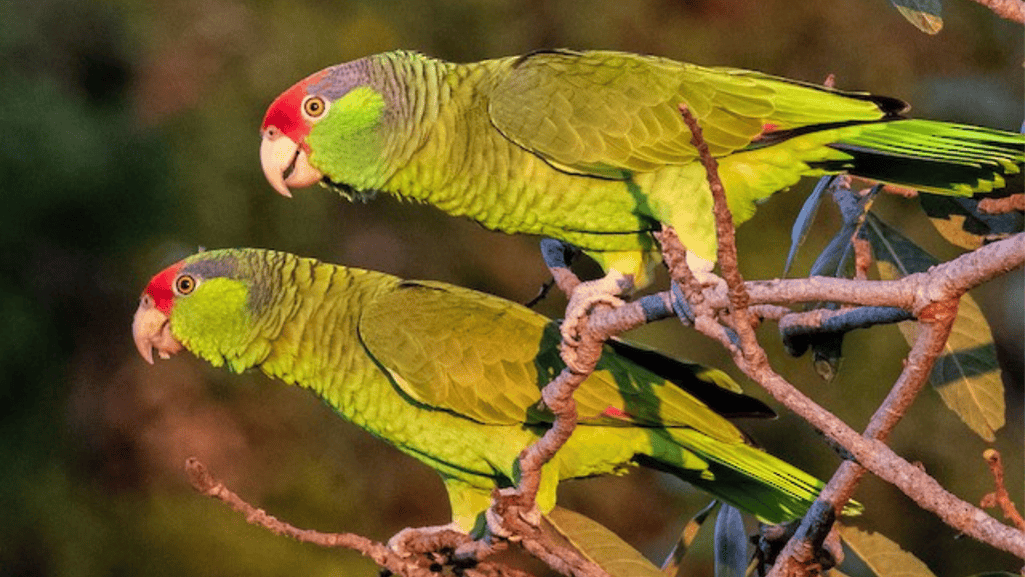
In winter and spring, birds take more flowers and nectar-rich buds when blooms are abundant.
By summer and autumn, they rely more on seeds and ripe fruit as seed crops mature.
Vegetation-based foods
Their plant diet includes fruit, buds, new leaves, and seeds from native trees and shrubs. Variety matters: different items supply vitamins, fiber, and energy.
Protein boosts and managed care
They also eat small invertebrates like aphids for extra protein. In conservation or aviculture, mealworms are sometimes offered as a supplemental treat.
Note: Supplemental feeding often supports reintroductions but is phased out once populations are self-sustaining, allowing natural foraging to resume.
- Flexible diet = better use of habitats and recovery in managed areas.
- Foraging occurs mostly in the canopy, at edges, and occasionally near dense ground cover.
Breeding and Nesting: Eggs, Incubation Period, and Chick Development
Pair bonds form the backbone of the breeding season, with courtship feeding beginning roughly two months before laying (often by mid-October). Pairs strengthen ties as the female inspects cavities and the male escorts her to potential sites.
Nest-site selection and locations
Nests appear in large tree holes most often, but birds also use cliff cavities, root hollows, abandoned seabird burrows, and manmade structures. Entrances frequently face north, and females do detailed checks before accepting a site.
Timing and clutch size
Egg laying typically runs November to January with a December peak. Typical clutches average about 7 eggs, though ranges of 4–9 are recorded. Eggs are laid a day or more apart.
Observed variation: in managed sites like Zealandia, breeding can start as early as mid-May and continue into December. Experienced pairs have fledged up to three broods there, and some monitored clutches averaged five eggs.
Incubation roles and feeding
The female incubates for 23–25 days while the male supplies food to her by regurgitation. This provisioning allows the female to keep eggs warm and protected.
Chick development timeline
- Hatching is staggered; chicks receive a clear viscous liquid first, then transition to solids.
- Eyes open at about day 9 post-hatch.
- Chicks leave the nest at ~30 days after hatching.
- Self-feeding often begins ~10 days after fledging.
- Full independence follows 4–5 weeks after leaving the nest.
Key takeaway: breeding follows a predictable calendar but shows local flexibility. Knowing nest choices, incubation roles, and exact day-based milestones helps both field observers and conservation managers track success.
Predators and Pressures: Why Mainland Populations Became Scarce
Introduced mammals are the main reason these birds declined on New Zealand’s main islands. Stoats, rats, and possums prey on eggs, chicks, and incubating females, cutting breeding success and adult survival.
Key introduced predators and their impacts
Stoats climb and enter cavities, taking chicks and incubating females at nest sites. Their agility makes many low or accessible nests vulnerable.
Rats raid eggs, nibble hatchlings, and can reduce entire clutches in a single night. Ship and bush rats have both been implicated in nest losses.
Possums eat eggs and also destroy food plants, lowering available resources for breeding pairs.
Why nesting ecology matters
Nests low to the ground or tucked among rocks and dense vegetation face far higher risk. Ground-level sites are easy for mammals to find, and incubation becomes dangerous when predators reach cavities.
- Accessible nests = higher egg and chick mortality.
- Loss of breeding adults reduces local population replacement.
- Habitat loss and fragmentation compound predator effects by limiting safe sites.
As a result, most persistent populations survive on predator-free islands and in fenced sanctuaries. Controlling mammal predators is essential for reintroductions and long-term recovery.
Status and Conservation: Protections, Reintroductions, and Current Monitoring
Conservation success combines strong laws, predator control, and careful monitoring. Globally the species is listed as IUCN Least Concern (IUCN 3.1), but mainland populations remain fragile where predators persist.
Legal safeguards and trade rules
The bird is absolutely protected under the New Zealand Wildlife Act 1953. It is also listed on CITES Appendix I, which restricts international commercial trade and helps curb illegal export.
Lessons from reintroductions
Early releases (Waitākere Ranges, 1976–1986) failed where predator control and monitoring were weak. By contrast, Tiritiri Matangi (2004–2006) succeeded in a predator-free setting.
Zealandia case study
Between 2010–2011, Zealandia moved 107 birds from Kāpiti Island in three releases. There were no aviary deaths; six pairs bred within two months. Intensive banding recorded 34 juveniles by mid‑2011 and more than 900 nestlings by 2018.
By 2015 the site supported 38 breeding pairs and was self-sustaining. Supplementary feeding stopped by late 2022 and nestboxes were removed after the 2024–25 season as birds preferred natural cavities.
Health monitoring
PBFD (psittacine beak and feather disease virus) has been detected in wild populations, so disease surveillance is a routine part of management and translocation planning.
- Interpretation: IUCN status is reassuring globally but masks local risk.
- Support: back predator control, sanctuaries, and lawful conservation efforts.
- Responsibility: avoid illegal trade and follow protection rules when keeping or studying birds.
Red Crowned Parakeet as a Pet: Aviculture Notes for Bird Lovers in the United States
Owning this lively New Zealand parrot in the United States demands routines that mirror its wild, social life. Prospective owners should prepare for high activity, frequent vocalizing, and a need for stimulating tasks.
Temperament and enrichment inspired by natural foraging
Active and social: these birds thrive on interaction. Daily out-of-cage time, supervised play, and consistent handling build trust and reduce stress.
Foraging-first enrichment: use puzzle feeders, timber shredding, and rotating perches to simulate canopy movement. Offer safe branches, chew toys, and food puzzles to mimic wild feeding patterns.
Captive breeding and color mutations versus wild-type plumage
They are common in aviculture and breed readily. Captive lines show mutations such as yellow, cinnamon, and piebald; later lines produced cyan tones not found in nature.
Note: mutated birds differ visually from wild-type birds and may attract different buyers. Breeding focus should prioritize health and temperament over novelty colors.
Ethical buying and regulated trade
Paperwork matters: CITES Appendix I controls international movement. Always ask for documentation and breeder records when purchasing in the U.S.
Prefer reputable, transparent breeders. Avoid sellers with vague import claims. Veterinary checks, microchipping, and clear provenance protect welfare and legal standing.
- Care priorities: space, social time, forensic enrichment, balanced diet, regular avian vet visits.
- Enrichment themes: puzzle feeding, shreddables, rotating perches, and climbing structures.
- Buying checklist: breeder references, CITES/permits, health certificates, microchip or band records.
Conclusion
Cyanoramphus novaezelandiae is a bright, canopy-loving New Zealand parrot now mostly found on predator-free islands and managed sanctuaries. Its clear forehead patch and wing flash make field ID reliable, and its loud calls mean you will often hear it before you see it.
Predator pressure explains mainland scarcity, while translocations and intensive monitoring have driven recovery in fenced reserves. These efforts show that protection and active management work.
Remember practical points: the species uses a varied diet, nests in cavities, and shows subtle sex and age differences useful for observers. Use calls, habitat, and visual cues together for confident identification.
Respect the science: use the proper name, support lawful trade standards, and favor conservation-minded aviculture in the United States.
FAQ
What is the scientific name of this New Zealand parakeet?
The species is known as Cyanoramphus novaezelandiae, a member of the parrot order Psittaciformes in the family Psittaculidae.
Where does this bird live in New Zealand and nearby islands?
It occurs across mainland forest blocks and on several offshore, predator-free islands. Populations persist on North Island remnants and island reserves such as Kapiti, Tiritiri Matangi, and Matiu/Somes. Historical and subspecies ranges include the Kermadec and Chatham islands; one former Macquarie Island form is now extinct.
How can I tell males and females apart?
Males often show stronger forehead and crown patches and slightly different underwing markings, while females are subtler. Juveniles have paler bills that darken and irises that change as they age.
What does their call sound like in the forest?
They produce soft, musical chatter at rest and sharper flight notes often described as repeated “ki-ki-ki” sounds. Their vocal style contrasts with the nearby yellow-crowned parakeet, which can sound harsher.
What do they eat throughout the year?
Diet shifts seasonally. In spring and winter they take many flowers and buds; in summer and autumn they eat seeds and fruit. They also consume leaves, buds, and occasional small invertebrates for protein.
Where do they nest and how many eggs do they lay?
Nests appear in tree cavities, cliff hollows, seabird burrows, and sometimes manmade structures. Clutch sizes vary but typically range from several eggs; females do most incubation while males supply food at the nest.
How long is incubation and when do chicks fledge?
Incubation is carried out primarily by the female and lasts the standard parrot period for this genus. Chicks hatch staggered, receive intensive feeding over several weeks, and fledge when fully feathered and independent enough to forage.
What predators threaten mainland populations?
Introduced mammals—rats, stoats, and brushtail possums—have driven declines. Ground- or low-nesting increases the risk of predation, which is why offshore predator-free islands are vital refuges.
What is the conservation status and legal protection?
Globally the species is currently listed as Least Concern by IUCN, reflecting many secure island populations. In New Zealand it benefits from legal protections under local wildlife law and international trade controls such as CITES listings for related species where applicable.
What conservation actions have helped recover populations?
Predator control, translocations, and reintroductions to fenced or predator-free reserves have proven effective. Notable projects include releases and monitoring at places like Tiritiri Matangi and Zealandia in Wellington, showing encouraging breeding and population growth.
Are there disease risks for wild and captive birds?
Psittacine beak and feather disease (PBFD) can affect populations, so health screening matters during translocations and in aviculture. Managers monitor disease as part of conservation and captive-breeding programs.
Can this species be kept as a pet in the United States?
They appear in aviculture, but potential owners should understand enrichment and social needs, legal constraints, and the ethics of purchase. Captive breeding produces color mutations, yet responsible sourcing and compliance with import regulations are essential.
How does their feeding behavior inform captive care?
Natural foraging includes searching for seeds, fruit, flowers, and insects. In captivity, birds need varied diets, puzzle feeders, and opportunities to forage to meet behavioral and nutritional needs.
What are the recognized subspecies and their fates?
Several subspecies are recognized across islands: the nominate form on main New Zealand islands, a Kermadec subspecies (C. n. cyanurus), a Chatham form (C. n. chathamensis), and the former Macquarie form († C. n. erythrotis), which is extinct.
How do field marks change in flight?
In flight you can see rump patches, a relatively long tail, and darker blue on the outerwing. These contrasts help identify the species at a distance against forest or coastal backgrounds.